
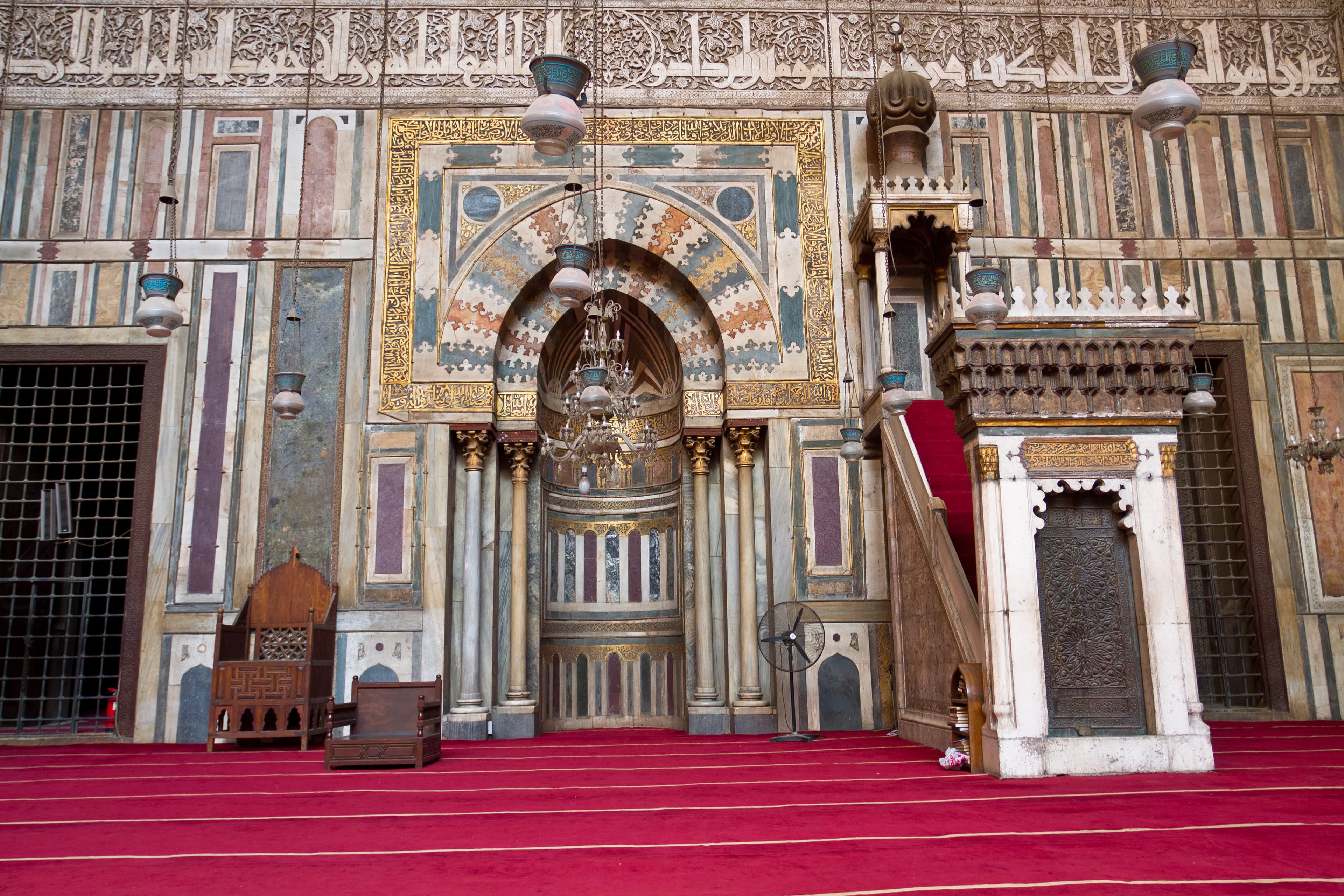

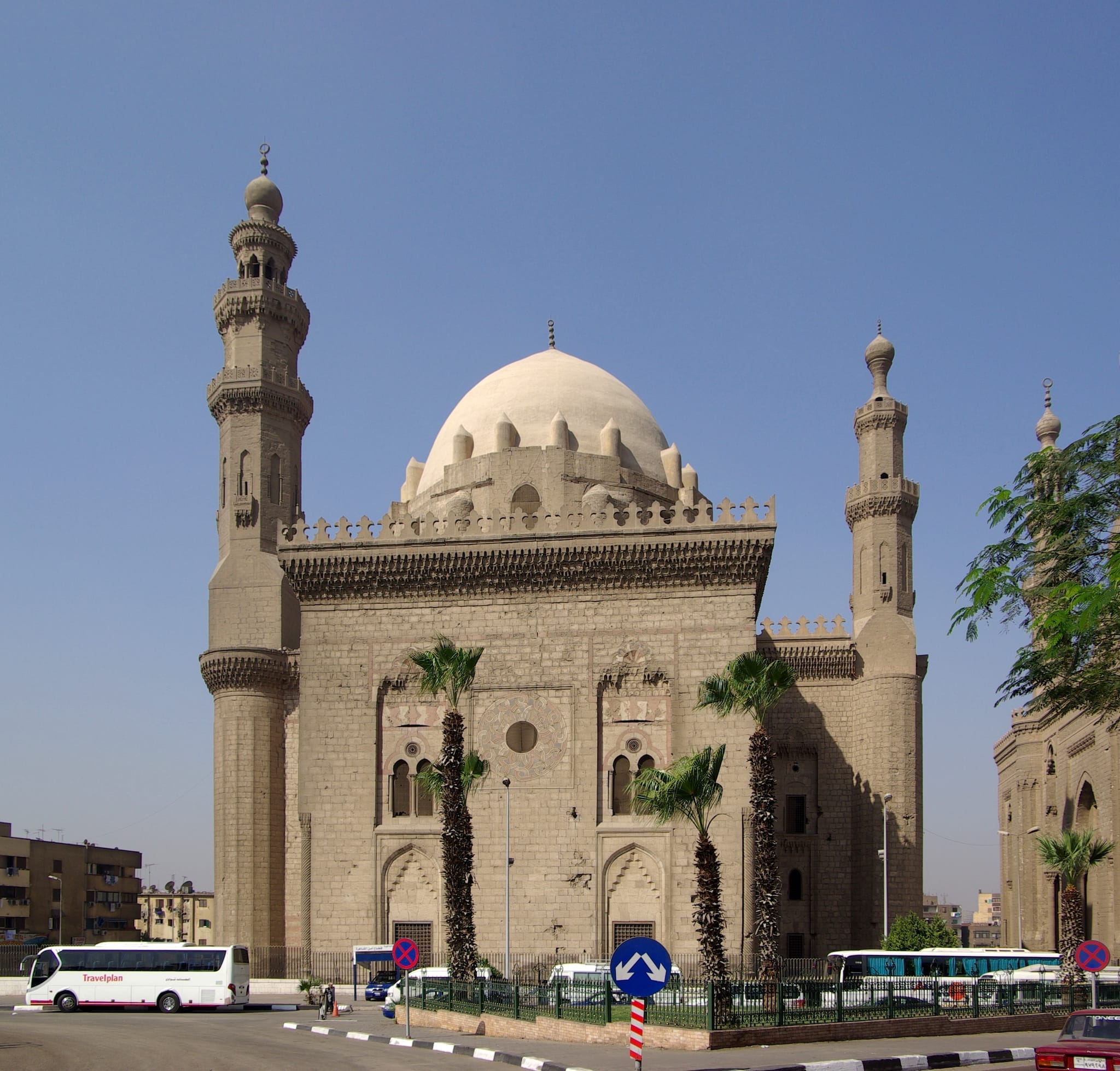
Standing majestically in the shadow of Cairo's Citadel, the Mosque and Madrasa of Sultan Hassan isn't just an old building; it's the absolute pinnacle of Mamluk architecture. We're talking about a breathtaking fusion of power, elegance, and artistic brilliance that has captivated visitors for over 650 years. This colossal structure cleverly combined a Friday congregational mosque with a full-blown educational complex, making it what many architectural historians consider the finest example of medieval Islamic architecture in Egypt.
Think of it this way: if the Pyramids of Giza show off Ancient Egypt's genius, then the Mosque and Madrasa of Sultan Hassan is Islamic Cairo's crowning jewel, hands down.
Built between 1356 and 1363 AD, during a really wild time for Cairo—plagues, political drama, and its patron's mysterious vanishing act—this monument tells a story as gripping as the man it was built for. Even today, it remains one of the largest mosques in the world and, honestly, an absolute must-see for anyone wanting to dig into Cairo's incredible Islamic heritage.
The Dramatic Life of Sultan Hassan
A Boy King's Tumultuous Reign
You can't really understand the Mosque and Madrasa of Sultan Hassan without knowing about the extraordinary life of the sultan himself. Sultan Hassan ibn al-Nasir Muhammad ibn Qalawun was basically thrown onto the Egyptian throne at just 13 years old in 1347 AD. He was born into the super powerful Mamluk dynasty, founded by his legendary grandfather, Sultan Qalawun. But being so young, Hassan was easily manipulated by the powerful court factions.
His first reign was pretty short before ambitious emirs booted the teenage sultan out. For a few years, other Mamluks ran Egypt while Hassan was basically a captive. But in 1356 AD, at around 22, Hassan pulled off an amazing political comeback, reclaiming his throne and immediately getting serious about consolidating his power.
Extravagance, Ambition, and Mystery
Stories from that time describe Sultan Hassan as incredibly extravagant, spending huge amounts on women, palaces, and massive construction projects. The historian Ibn Kathir even criticized him for blowing public funds and being greedy—accusations that definitely lined up with the massive costs of his grand mosque. But this same extravagance also showed Hassan's fierce determination to prove he was a legitimate, powerful ruler who deserved to be on that throne.
In 1361 AD, just before the Mosque and Madrasa of Sultan Hassan was finished, Sultan Hassan was tragically assassinated by Yalbugha al-Umari, his commander-in-chief, whom he had trusted completely. The rebellion apparently came from Hassan's favoritism and lavish spending, which really rubbed the powerful military commanders the wrong way.
And here's the kicker: Hassan's body was never found after his assassination. The elaborate mausoleum built inside his mosque—meant to be his final resting place—is still empty to this day, adding a really eerie twist to this architectural masterpiece.
Architectural Marvel: Design and Innovation
Unprecedented Scale and Dimensions
The sheer size of the Mosque and Madrasa of Sultan Hassan is just mind-boggling. The complex covers nearly 8,000 square meters, with the building itself stretching about 150 meters long. The towering entrance portal climbs to an astonishing 36.7 meters—making it one of the tallest and most majestic in all of Islamic architecture.
The surviving minaret reaches 68 meters above Cairo's streets, still dominating the skyline today. What really makes these dimensions incredible is the historical context: construction happened during repeated outbreaks of the Black Plague, which devastated Cairo throughout the mid-14th century.
That such a monumental building could even be finished during such a catastrophic time really speaks volumes about both the resources the Mamluk state could command and Sultan Hassan's iron will to leave an immortal legacy.
¿Quieres explorar The Mosque and Madrasa of Sultan Hassan: Cairo's Mamluk Masterpiece?
Permítenos diseñar el itinerario privado perfecto para ti. Desde expertos guías locales hasta cruceros de lujo, creamos viajes a medida que te muestran el Egipto real.
Personalizar por WhatsAppTours en El CairoPaquetes de Viaje a EgiptoCruceros por el Nilo
The Cruciform Madrasa Plan
Unlike many mosques just built for Friday prayers, this one followed a cruciform madrasa plan—an architectural layout specifically designed for religious education. The whole building centers on this magnificent open courtyard, surrounded by four massive iwans (vaulted halls). Each iwan was a classroom for one of the four schools of Sunni Islamic law: Hanafi, Maliki, Shafi'i, and Hanbali.
This groundbreaking design truly showed the Mamluk commitment to religious education and tradition. Each iwan even had living quarters for students and teachers, creating a complete little educational community right within the mosque complex. The largest and most ornately decorated iwan faces Mecca, serving as the main prayer hall and beautifully blending educational and devotional functions.
The Magnificent Central Courtyard
Walking through the dark entrance corridor, you suddenly emerge into this breathtaking central courtyard—a peaceful, square space that just overwhelms you with its vertical grandeur. The four soaring iwans rise dramatically on all sides, their massive arches framing the sky above. Right in the center of the courtyard, you'll find an ornate ablution fountain, finished in 1364 AD, where worshippers cleanse themselves before prayers. The imposing height of the courtyard was calculated perfectly to inspire awe and reverence. It's a fantastic balance between massive scale and refined proportions, creating spaces that feel both monumental and wonderfully harmonious.
This blend of strength and elegance truly defines the Mosque and Madrasa of Sultan Hassan, showing just how sophisticated Mamluk architects were with spatial dynamics.
The Qibla Iwan: Architectural Ambition
The eastern iwan, which points towards Mecca (the qibla), is definitely the mosque's architectural and decorative high point. Chroniclers of the time even recorded that Sultan Hassan specifically ordered this arch to be 'five cubits wider' than the famous Sasanian Taq-i Kisra arch in Ctesiphon, Iraq—then considered the world's widest unsupported arch.
While the arch at the Mosque and Madrasa of Sultan Hassan didn't quite hit that incredibly ambitious goal, the comparison really highlights Hassan's global architectural ambitions, his desire to outdo the greatest monuments of past civilizations. The qibla wall inside this iwan is just spectacularly decorated. Rich marble panels form an elaborate dado (the lower wall section), featuring intricate geometric patterns in multiple colors. Above this, a unique stucco text band inscribed with Quranic verses in beautiful Kufic calligraphy wraps completely around the iwan. The mihrab (the prayer niche showing the direction of Mecca) shows off extraordinary craftsmanship, flanked by columns reportedly taken from Crusader castles—trophies of Mamluk military victories now integrated into sacred architecture.
Revolutionary Minaret Design
¿Quieres explorar The Mosque and Madrasa of Sultan Hassan: Cairo's Mamluk Masterpiece?
Permítenos diseñar el itinerario privado perfecto para ti. Desde expertos guías locales hasta cruceros de lujo, creamos viajes a medida que te muestran el Egipto real.
Personalizar por WhatsAppTours en El CairoPaquetes de Viaje a EgiptoCruceros por el Nilo
Defining Cairo's Iconic Skyline
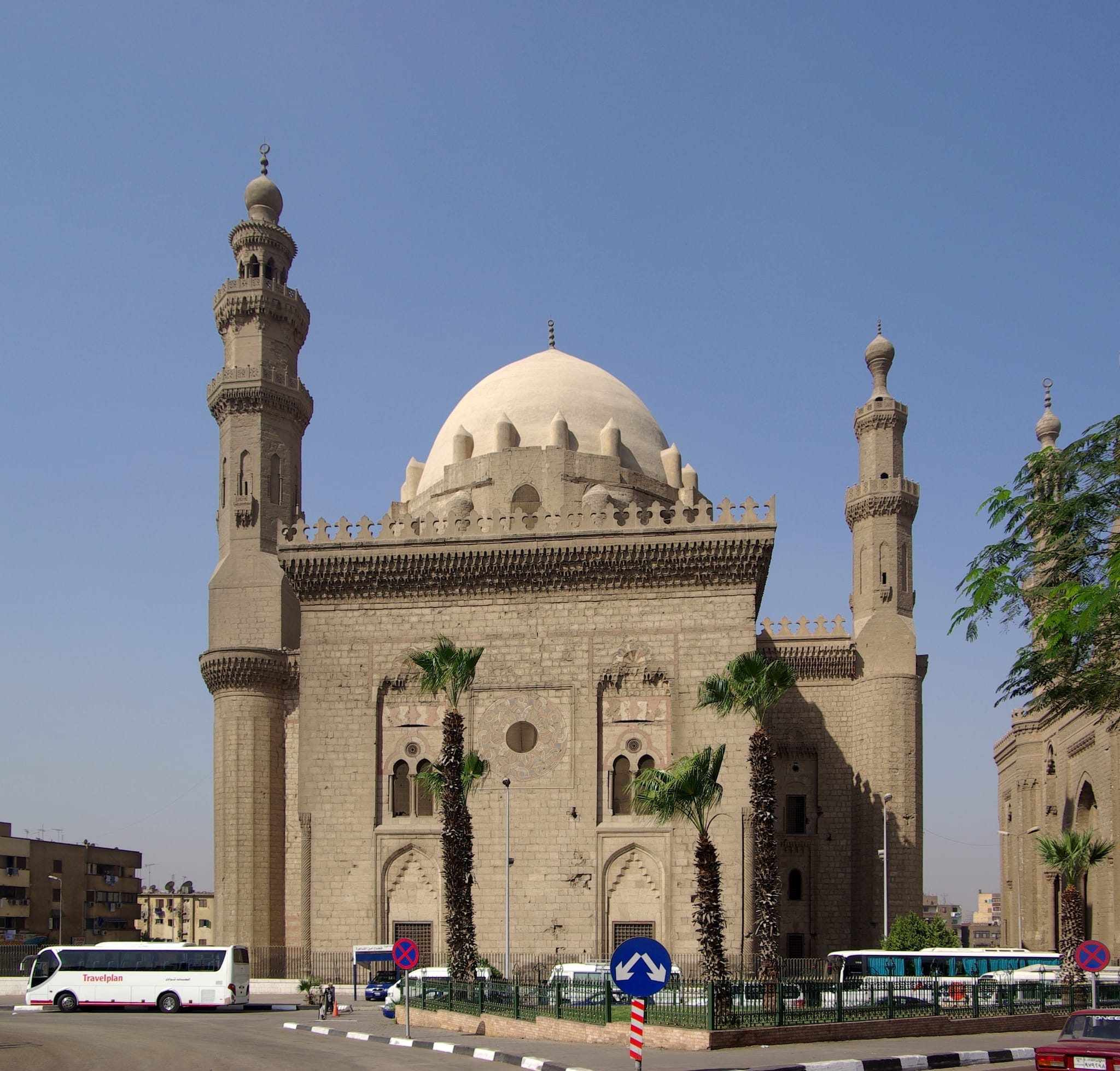
The Mosque and Madrasa of Sultan Hassan actually introduced the iconic three-tiered minaret design that became the signature of Mamluk religious architecture and forever shaped Cairo's distinctive skyline. The surviving minaret (they originally planned four, but one collapsed during construction, killing 300 people—yikes) perfectly shows this innovative approach. The minaret's lower stories blend beautifully into the mosque's walls. Above this, the structure smoothly transitions from a square base to an octagonal middle section with small balconies.
A larger balcony, adorned with intricate muqarnas (those cool stalactite-like ornamental elements), separates the middle tier from the upper section. The very top features an open colonnade pavilion capped with another ring of muqarnas, leading up to a tapered stone bulb finial. This design was so influential; it was copied and refined throughout the Mamluk period by later architects, becoming the standard for Cairo's minarets. If you look across Islamic Cairo today, you can really spot the influence of the Mosque and Madrasa of Sultan Hassan's innovations on countless other buildings.
Exquisite Decorative Details
Marble, Stucco, and Bronze Masterworks
Seriously, every surface of the Mosque and Madrasa of Sultan Hassan got meticulous artistic attention. The marble work alone is some of the finest stone craftsmanship in Islamic architecture, with complex geometric patterns, floral motifs, and calligraphic inscriptions executed with a precision that just seems impossible given the tools they had back then.
The magnificent bronze doors—huge copper-plated structures—were originally here but later moved to the Mosque of al-Mu'ayyad Sheikh, where they are now. Their removal is just one example of the many changes the building saw over centuries, as later rulers either took its treasures or modified its spaces.
The stucco decoration, especially those Kufic text bands in the qibla iwan, really shows off the Mamluk mastery of three-dimensional decorative effects. The letters pop out from the wall, creating dramatic shadows as the light changes throughout the day. This blend of calligraphy, ornament, and architectural function is a perfect example of Islamic art's holistic approach, where beauty and meaning are completely intertwined.
The Construction Supervisor's Honor
There's an unusual inscription near the entrance of the Mosque and Madrasa of Sultan Hassan that actually records the name of Amir Muhammad ibn Biylik al-Muhsini, who oversaw the mosque's construction. His name appears remarkably close to Sultan Hassan's own name in the inscription—an unprecedented honor that really shows how prestigious this project was.
This supervisor had previously been governor of Cairo and managed other big construction projects, including renovations to the hippodrome near the Citadel, originally built by the legendary Mamluk Sultan Baybars.
A Turbulent History: From Construction to Today
Completion Without Its Patron
When Sultan Hassan was assassinated in 1361 AD, the construction of the Mosque and Madrasa of Sultan Hassan didn't just stop. It kept going under the supervision of Bashir al-Jamdar, one of his assistants. Work continued until about 1363 AD, with final touches like the marble floor, the courtyard fountain dome (finished 1364 AD), and various decorative elements.
However, the mosque was never truly finished exactly as planned—some intended elements never happened, and the original four minarets were reduced to two (and later just one) after a catastrophic collapse.
Centuries of Conflict and Damage
This mosque's prime location, right near the Citadel, repeatedly made it vulnerable during conflicts. During various political uprisings, the Mosque and Madrasa of Sultan Hassan was actually used as a military position, with soldiers firing cannons from its elevated spots.
Chronicles from 1660 AD describe the mausoleum's dome as being riddled with cannonball holes—damage that took years to fix. In 1659, the northern minaret attached to the mausoleum actually collapsed. Between 1671-1672, it was replaced with a smaller minaret that had a slightly different design. Around the same time, the original wooden dome over the mausoleum was swapped out for the current stone dome, which also looks different from the original plan.
These changes really show how the building evolved over time, with each era leaving its own architectural mark. During the Ottoman period, the Mosque and Madrasa of Sultan Hassan was apparently closed for many years after unrest in 1736, only reopening in 1786 by order of Salim Agha. There were even several attempts to tear down parts of the structure over the centuries, though Cairo's population often spoke out against these efforts, putting pressure on authorities to repair damages instead.
The Ar-Rifa'i Mosque: A Grand Neighbor
Neo-Mamluk Revival in the 19th Century
In 1869, construction kicked off on the Mosque of Ar-Rifa'i, right next door to the Mosque and Madrasa of Sultan Hassan. This incredibly ambitious project, which wasn't even finished until 1912, was built in a neo-Mamluk style. It was deliberately designed to complement Hassan's mosque while also serving as a royal mausoleum for Egypt's modern ruling dynasty.
The Ar-Rifa'i Mosque houses the tombs of several Egyptian rulers, including King Farouk (Egypt's last king), and notably, the final resting place for Mohammad Reza Pahlavi, the last Shah of Iran. Together, the Mosque and Madrasa of Sultan Hassan and the Ar-Rifa'i Mosque now dominate the historic Rumayla Square (now called Midan Salah ad-Din), creating one of Cairo's most impressive architectural duos. Their combined presence offers visitors a really cool opportunity to compare 14th-century Mamluk architecture with 19th-century neo-Mamluk revival, appreciating both the historical authenticity and later interpretations.
Visiting the Mosque and Madrasa of Sultan Hassan
Practical Information for Travelers
Located directly across from the Citadel of Cairo in Midan Salah ad-Din (Saladin Square), the Mosque and Madrasa of Sultan Hassan is super easy to get to from central Cairo. The mosque typically opens daily from about 9 AM to 5 PM, though hours can sometimes change, so it's always good for me to double-check. Entrance tickets (currently 220 EGP for foreign adults, 110 EGP for students) include admission to the adjacent Ar-Rifa'i Mosque, which is amazing value for seeing two extraordinary buildings.
What to Wear and Bring
- Visitors should dress modestly; both men and women should cover their shoulders and knees. Ladies, it's a good idea to bring a headscarf to cover your hair. Comfortable walking shoes are a must, as you'll take them off before entering prayer areas.
- The sheer size of the Mosque and Madrasa of Sultan Hassan means quite a bit of walking, and some of the stone floors can be a bit uneven.
- Photography is generally allowed, but please be respectful and avoid taking pictures of people praying.
- The dramatic architecture and the way light plays through the courtyards and iwans create some truly spectacular photo opportunities, especially during the 'golden hour' in the late afternoon.
Making the Most of Your Visit
- Give yourself at least 60-90 minutes to really take in the Mosque and Madrasa of Sultan Hassan.
- Start by pausing at the entrance to admire that towering portal before walking through the corridor into the courtyard.
- Stand in the center of the courtyard to truly appreciate the overwhelming scale and proportions from every angle.
- Explore each of the four iwans, paying extra attention to the incredibly intricate decoration of the qibla iwan.
- Visit the mausoleum chamber; it's quite moving, especially considering the irony that Sultan Hassan, who commissioned this magnificent tomb, was never actually buried here.
- Take some time to look closely at the marble work, and marvel at the precision of those geometric patterns and calligraphic inscriptions.
- Consider hiring a knowledgeable guide. They can really bring to life the architectural innovations, the historical context, and all those symbolic meanings woven throughout this incredible place.
The stories behind this mosque—Sultan Hassan's dramatic life and mysterious death, the catastrophic minaret collapse, the centuries of conflict and restoration—really add an immeasurable depth to the visual experience.
Combining Your Visit: Islamic Cairo Highlights
A Perfect Day of Islamic Architecture
The Mosque and Madrasa of Sultan Hassan's location makes it absolutely perfect for combining with other Islamic Cairo highlights. The Citadel of Cairo is right above it, housing the Muhammad Ali Mosque (the Alabaster Mosque), whose Ottoman architectural style offers a fascinating contrast to Mamluk design. The Ibn Tulun Mosque is a comfortable walk (or a short taxi ride) away, giving you a completely different architectural experience from the 9th century, with its Samarran style, vast courtyard, and unique spiral minaret showing off early Islamic Egyptian architecture. The adjacent Gayer-Anderson Museum provides fascinating insights into Ottoman-era domestic life in beautifully restored historic houses. For travelers with good stamina, Al-Azhar Mosque and Al-Muizz Street's concentration of Fatimid, Ayyubid, and Mamluk monuments can easily be visited on the same day. This creates a really comprehensive tour through five centuries of Islamic Cairo's architectural development.
Why the Mosque and Madrasa of Sultan Hassan Matters
Architectural Innovation and Influence
The Mosque and Madrasa of Sultan Hassan wasn't just another building; it was a watershed moment in Islamic architecture. Its successful blend of monumental scale with refined decoration, its pioneering minaret design, its sophisticated spatial organization, and its masterful craftsmanship set new standards that influenced centuries of subsequent building. Architectural historians rightly see it as 'the finest piece of early Mamluk architecture in Cairo' and one of the most ingeniously designed mosques in Islamic architectural history. No other single Mamluk monument really showcases as many architectural innovations as this one. Its influence reached far beyond Egypt, inspiring architects across the Islamic world to emulate its designs and decorative programs.
A Window Into Medieval Cairo
Beyond its architectural brilliance, the Mosque and Madrasa of Sultan Hassan offers profound insights into medieval Cairo's social, political, and religious life. The integration of educational facilities clearly demonstrates the Mamluk commitment to religious learning. The sheer massive scale reflects their incredible wealth and power. And the building's survival through centuries of conflict, damage, and restoration really illustrates Cairo's resilience and the ongoing reverence Egyptians hold for their Islamic heritage.
¿Listo para convertir esta guía en realidad?
Nuestros expertos locales pueden crear un itinerario personalizado basado en estas recomendaciones. ¡Solo envíanos un mensaje rápido!
Personaliza a través de WhatsApp