
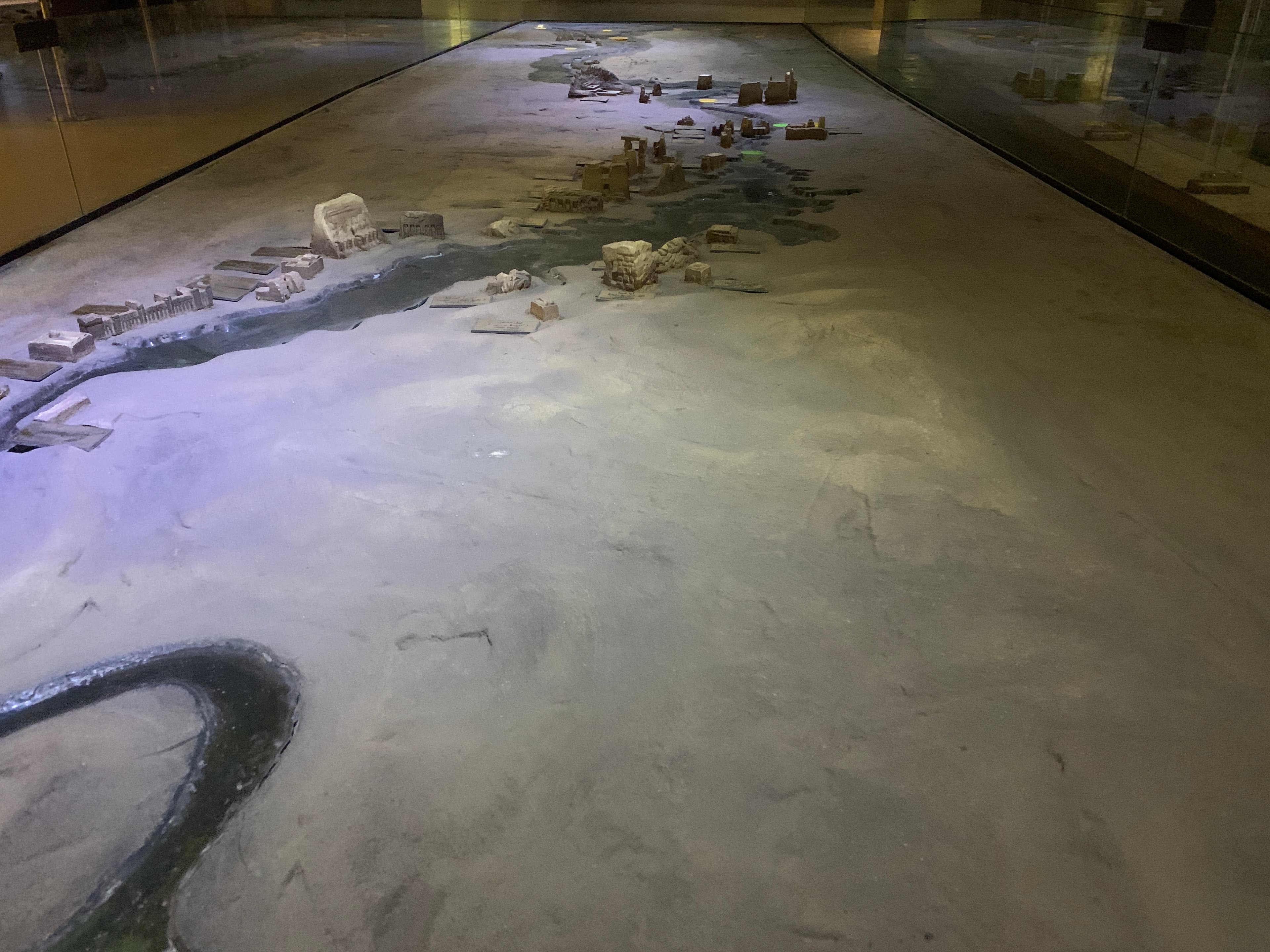

When you think of ancient Egypt, you're really thinking about the Nile River. This incredible waterway, stretching over 6,650 kilometers and touching 11 countries, is the undeniable lifeblood of what became one of history's greatest civilizations. Even though its valley is often less than a kilometer wide, the Nile's fertile, silt-rich waters—mostly from the powerful Blue Nile—didn't just sustain life; they allowed a phenomenal culture to thrive right in the middle of a desert.
The Unstoppable Force: How Geography Made the Nile Valley Unique
Imagine a slender green ribbon, winding its way through an endless, golden desert. That's the Nile Valley, a narrow oasis perfectly sculpted by nature to become an unparalleled cradle of civilization. Its truly exceptional geography offered the ideal conditions for farming and human settlement, setting it apart from just about any other ancient region on Earth.
The Nile River's Unique Flow
The Nile does something most rivers don't: it flows northward! Starting high in the Rwandan and Burundian mountains, it makes its way all the way to the Mediterranean Sea. Its two main arteries—the consistent White Nile and the powerful, sediment-rich Blue Nile—join forces to keep the river flowing, constantly nourishing the lands downstream.
Seasonal Flooding: Nature's Gift
Every single year, like clockwork, the Nile would gently flood between May and September. This wasn't a destructive event; it was a blessing. The floods deposited nutrient-rich silt, making the soil incredibly fertile and allowing ancient Egyptian agriculture to flourish. This predictable cycle was so crucial that it shaped their entire calendar: Akhet (flooding), Peret (growing), and Shemu (harvest).
They even used 'Nilometers' to precisely measure the water levels, showing just how much their lives depended on this rhythm.
Climate and Natural Protection
The desert climate surrounding the Nile Valley naturally pushed people to live right along the riverbanks, fostering the growth of complex societies. These natural boundaries – vast deserts to the east and west, the Mediterranean to the north, and the Aswan cataracts to the south – weren't just geographical features; they were protective shields. Thanks to the reliable water and fertile land, civilization didn't just survive here, it thrived.

From Wandering to Cultivating: The Nile's Role in Early Agriculture
Around 6000 BCE, as the Sahara deserts grew drier, people naturally migrated towards the Nile. This wasn't just a move; it sparked a fundamental shift from a nomadic existence to a settled, farming life, laying the groundwork for the incredible civilization that would become ancient Egypt.
Want to explore The Enduring Heartbeat of Egypt: Exploring the Nile Valley?
Let us design the perfect private itinerary for you. From expert local guides to seamless luxury cruises, we craft custom trips that show you the real Egypt.
Customize via WhatsAppEarly Farmers: Mastering Plants and Animals
By 5000 BCE, farmers in the Nile Valley were absolute masters. They'd domesticated crops like wheat, barley, flax, and sorghum, alongside animals like cattle, sheep, goats, and pigs. But they didn't stop there. They broadened their agricultural repertoire to include fruits, vegetables, and legumes, showing a real specialization. Think about it: they bred cattle specifically for meat or milk, developed 'fat-tailed' sheep for dual purposes, and even had distinct hunting dogs!
Ingenious Irrigation and Farming Techniques
Ancient Egyptian engineers were truly brilliant. They perfected 'basin irrigation' by building earthen embankments parallel and perpendicular to the Nile, creating interconnected basins to manage floodwaters with incredible efficiency. We even have artistic proof of organized water control from as early as 3100 BCE, like the ceremonial mace head of the Scorpion King. Farming itself relied on wooden plows pulled by oxen or donkeys, often using a 'dual-plowing' method to get the soil just right.
By the 4th Dynasty, around 2525 BCE, their agriculture was a highly organized system, overseen by a dedicated bureaucracy.
The Birth of Communities: Villages and Towns
Different Nile cultures mark the progression of early Egypt. The Merimde culture (5000–4200 BCE) built simple settlements; El Omari (4000–3100 BCE) followed similar ways of life; Maadi brought in copper metallurgy and gained prominence. But it was the Gerzean culture (3500–3200 BCE) that truly advanced agriculture and urbanization, essentially bridging the gap from Predynastic Egypt to the mighty Dynastic period.

The Nile's Indelible Mark on Ancient Egyptian Civilization
As populations moved closer to the Nile's rich banks, competition for resources naturally heated up, leading to the growth of walled towns and, eventually, a unified state. The Nile didn't just support Egyptian life; it shaped every single aspect of it, becoming the fundamental pillar of their remarkable civilization.
Want to explore The Enduring Heartbeat of Egypt: Exploring the Nile Valley?
Let us design the perfect private itinerary for you. From expert local guides to seamless luxury cruises, we craft custom trips that show you the real Egypt.
Customize via WhatsAppThe Rise of Centralized Government
Managing the Nile's floods wasn't just a practical matter; it fostered a spirit of cooperation that ultimately led to Egypt's powerful, unified state. Pharaohs weren't just rulers; they were orchestrators, directing irrigation and agriculture through vast bureaucracies of scribes and administrators. This centralized control managed everything, from granaries to wealth distribution.
Imagine skilled laborers receiving about 200 kg of grain monthly, while supervisors got around 250 kg – a real testament to how organized they were!
Spiritual Connection: The Nile in Religion
Egyptian spirituality was deeply intertwined with the Nile's rhythms. Hapi, the god personifying the annual flood, was a central figure, representing fertility and abundance. Their religious observances moved in perfect sync with the river's cycles. The Festival of the Nile, for instance, celebrated the rising floodwaters around mid-July.
Their three distinct seasons—Akhet (flooding), Peret (growing), and Shemu (harvesting)—weren't just agricultural terms; they were sacred markers of life itself.
Trade and Travel: The Nile's Highway
Egypt's commercial lifeline was, without a doubt, the Nile. It was the ancient world's superhighway, connecting the kingdom to distant lands and vibrant cultures. Trade networks stretched as far as India, the Fertile Crescent, Arabia, and Sub-Saharan Africa. Consider the Darb el-Arbain route, winding through Kharga and Asyut, a vital artery carrying gold, ivory, spices, and exotic goods between Nubian territories and Egyptian markets.
Egypt's agricultural surpluses became prized exports, while essential imports like timber and precious metals flowed inward with the current.
Architectural Feats and Cultural Brilliance
The Nile didn't just inspire; it enabled. Egyptian art and architecture, with boat imagery appearing on vessels as early as 3500–3300 BCE, clearly show its influence. More importantly, its waters were the ultimate transport system for massive stones, drastically speeding up the construction of their monumental works.
Temples along its banks often featured grand gateways, expansive courtyards, and sacred shrine chambers, with styles evolving through the rich cultural exchanges facilitated by river trade.

Ready to turn this guide into reality?
Our local experts can create a custom itinerary based on these recommendations. Just send us a quick message!
Customize via WhatsApp