


When we talk about ancient Egypt, certain names always pop up: Tutankhamun, Ramses II, Cleopatra. But there's another pharaoh, perhaps even more remarkable, whose story deserves to be front and center: Queen Hatshepsut. She wasn't just a queen; she was a *pharaoh*, one of the earliest and most successful women to ever rule Egypt independently. Her reign (around 1479–1458 BC) was a period of stunning peace, prosperity, and monumental achievements.
She truly defied every expectation in a world dominated by men, leaving behind a legacy that still captivates us today.
How Hatshepsut Got to the Throne
Hatshepsut's path to power wasn't a straight line; it was a brilliant maneuver through the complex politics of ancient Egypt. When Pharaoh Thutmose II died in 1479 BCE, his infant son, Thutmose III, was simply too young to run a kingdom. This created a vacuum, and Hatshepsut stepped right into it.
The Political Scene After Thutmose II's Death
Imagine the tension: a child king, Thutmose III, inherits the throne. His mother wasn't of royal blood, which created a slight legitimacy issue. Hatshepsut, being his stepmother and the late king's widow, became the natural choice to act as regent. She was, in essence, the guardian of the throne for the young heir.
From Regent to Rightful Pharaoh
For about two years, Hatshepsut played the traditional role of regent, always acknowledging Thutmose III as the true king. But then, something truly extraordinary happened between the second and seventh year of her regency. Hatshepsut made a move that was, to put it mildly, unprecedented. She had herself crowned as king, adopting all the full titles and regalia that traditionally belonged to a male pharaoh.
She even backdated her ascension to Thutmose III's first year, positioning herself not just as a regent, but as his senior co-ruler.
Think about that for a moment. In a society where the pharaoh was literally seen as a living god, and that god was almost always male, Hatshepsut broke every single mold.
The Help of Powerful Allies: Senenmut
Of course, Hatshepsut didn't do this alone. She had the unwavering support of key officials, most notably Senenmut. This man rose from humble beginnings to become one of the most powerful figures in Egypt, holding a staggering 93 titles! He was the 'Overseer of Works' and the 'Great Steward of Amun,' which meant he had immense influence over massive projects, including the sacred Karnak Temple.
By carefully placing loyal and capable people like Senenmut in crucial positions, Hatshepsut cemented a strong power base for her reign.
A Peaceful Reign Focused on Prosperity
Hatshepsut actively positioned herself as a restorer, leading Egypt out of a period of perceived turmoil. During her two-decade rule, she made a conscious choice to prioritize peace and economic strength over military conquest. She led only one brief campaign into Nubia early on, but her true focus was always on trade and growth.
Want to explore Queen Hatshepsut: Egypt's Trailblazing Female Pharaoh?
Let us design the perfect private itinerary for you. From expert local guides to seamless luxury cruises, we craft custom trips that show you the real Egypt.
Customize via WhatsAppShifting From Warfare to Diplomacy
This was a huge departure from most pharaohs. Instead of endless wars, Hatshepsut focused on diplomacy. She maintained Egypt's defenses, sure, but her real genius was in reopening and strengthening trade networks. She re-established connections with Western Asia, the Aegean, and regions to the south, bringing immense wealth back into Egypt and securing lasting economic success for the kingdom.
The Legendary Punt Expedition
Her most famous commercial exploit, without a doubt, was the grand expedition to Punt, around the ninth year of her reign. This wasn't some quick trip; it was a bold, ambitious venture. Five large ships, carrying over 200 men, sailed across the treacherous Red Sea to a land that scholars generally believe was located in modern-day Somalia or Eritrea.
The treasures they brought back were incredible: 31 living myrrh trees (an unprecedented feat!), frankincense, shimmering gold, exotic ivory, dark ebony, and even live baboons. These weren't just pretty objects; they served practical and ceremonial purposes. Hatshepsut famously used the myrrh on her skin and was the first documented ruler to use frankincense in kohl eyeliner. Pretty glamorous, right?
The act of transplanting those live myrrh trees is particularly mind-blowing. It's the first recorded attempt at plant relocation in history – a truly advanced horticultural achievement that showed the expedition's value went far beyond simple economics.
Economic Flourishing Under Her Rule
Thanks to these smart trade initiatives, Egypt's economy absolutely boomed. Hatshepsut even commissioned the building of specialized ports along the Red Sea, like Saww (modern Mersa Gawasis). These new ports allowed for direct trade, cutting out the middlemen who had previously controlled access to those valuable goods.
The wealth generated from these expanded commercial networks funded all of Hatshepsut's ambitious building projects across Egypt. Her unwavering focus on economic development, rather than military expansion, transformed Egypt into one of the wealthiest and most powerful nations in the ancient world.

Building a Lasting Legacy in Stone
Hatshepsut wasn't shy about her aspirations for eternal glory. She launched extensive building projects all over Egypt, creating monuments and temples that would forever symbolize her powerful reign.
Want to explore Queen Hatshepsut: Egypt's Trailblazing Female Pharaoh?
Let us design the perfect private itinerary for you. From expert local guides to seamless luxury cruises, we craft custom trips that show you the real Egypt.
Customize via WhatsAppHer Masterpiece: The Mortuary Temple at Deir el-Bahari
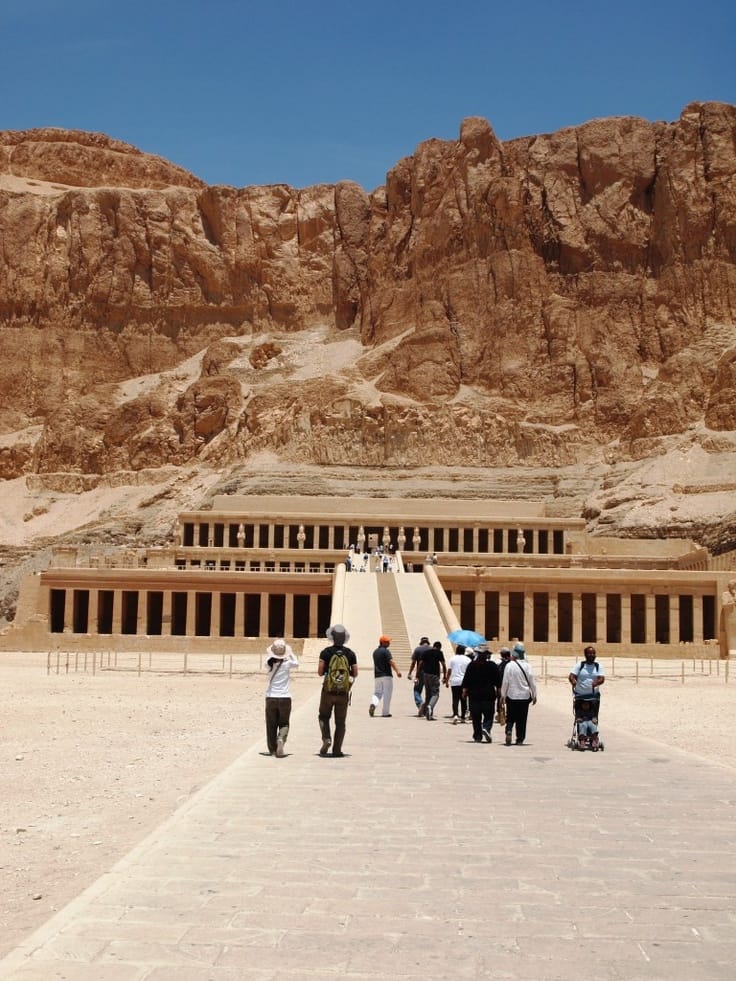
If you've ever seen photos of Egypt's west bank in Luxor, you've almost certainly seen Deir el-Bahari. This magnificent temple, known as Djeser-Djeseru ('the Holy of Holies'), was Hatshepsut's architectural triumph, designed by her trusted steward, Senenmut. Its three massive terraces rise dramatically out of the limestone cliffs, connected by elegant ramps – it's breathtaking.
Construction took about 14 to 16 years, which is incredibly fast when you consider other monuments were also being built simultaneously. The temple's design was truly groundbreaking, with colonnaded sections mirroring the natural cliff formations.
Each terrace had distinct religious purposes: the second level featured shrines for goddesses Hathor and Anubis, while the uppermost level contained the Royal Cult Chapel, Solar Cult Chapel, and the sacred sanctuary of Amun, carved right into the rock face.
Obelisks and Temples at Karnak
Not content with just one masterpiece, Hatshepsut also left her mark at Karnak. She erected twin obelisks at the temple entrance, which were, at the time, the tallest in the world. Today, one still stands, a towering structure about 30 meters high and weighing a mind-boggling 323 tons! Imagine the sheer engineering required to move these monuments – historians believe it took 27 ships and 850 oarsmen. It was an epic undertaking for sure.
She also restored Karnak's Precinct of Mut, which had been damaged during the Hyksos occupation, and built the 'Red Chapel' (Chapelle Rouge) as a barque shrine. These projects solidified her deep devotion to Amun, the deity whose support helped legitimize her rule.
Symbolism in Her Architectural Choices
Hatshepsut was a master of political messaging, and she used her architecture to tell her story. The reliefs at Deir el-Bahari vividly depict her divine birth, asserting that Amun himself was her true father. This wasn't vanity; it was a powerful claim to her divine right to rule. Mummiform statues on the temple's top level showed her as Osiris, further linking her to the afterlife and the divine essence of kingship.
Her decision to build her mortuary temple right next to Mentuhotep II's older structure was also strategic. It connected her to a respected ruler who had united Egypt centuries before, subtly reinforcing her own legitimacy. Her monuments often blended seamlessly with the natural landscape, especially at Deir el-Bahari, symbolically intertwining her reign with Egypt's timeless geography.

Erased from History, But Remembered Today
Then, about 20 years after Hatshepsut's death, something truly baffling happened: a systematic attempt to wipe her legacy clean from the history books. This effort to erase one of Egypt's most successful rulers offers us a glimpse into the ruthless political machinations of the ancient world.
The Defacement of Her Monuments
The campaign was thorough and brutal. Workers painstakingly hacked away her images from monuments across Egypt. Statues at her mortuary temple weren't just broken, they were meticulously shattered at specific points – the neck, waist, and knees. Recent archaeological studies show this wasn't random vandalism; it was a calculated 'deactivation' of her statues, deliberately stripping them of their spiritual power.
Her cartouches (royal names) were chiseled off walls, sometimes replaced with the names of Thutmose I or II.
Why the Eradication?
For a long time, people assumed Thutmose III, her stepson, harbored a deep personal hatred for Hatshepsut and erased her memory out of spite. But new evidence suggests more nuanced reasons. The timing is key: the erasure began roughly two decades after her death. Scholars now believe it was a calculated political move, not emotional revenge. Ancient Egyptians believed royal statues contained spiritual power, which needed specific rituals to neutralize.
This erasure likely served to strengthen Amenhotep II's claim to the throne through his father's male lineage, ensuring that a female ruler wouldn't set a precedent and challenge future succession.
Modern Reassessment and Her Enduring Legacy
Hatshepsut remained largely forgotten until Egyptologists rediscovered her in the mid-nineteenth century. Through painstaking archaeological work, scholars gradually pieced together her incredible story. The 1920s excavations at Deir el-Bahari unearthed many broken statues, which, once reassembled, helped researchers understand the magnificent scope of her reign.
Modern studies of these artifacts have completely reshaped our understanding of her achievements and the complex reasons behind the attempt to erase her.
Impact on Perceptions of Female Leadership
The historian James Henry Breasted once called Hatshepsut 'the first great woman in history.' Her reign is a powerful testament to the fact that women could, and did, lead nations with immense success, even in societies that often limited their roles.
If you truly want to connect with Queen Hatshepsut's legacy, there's no better way than to see her architectural marvels firsthand. A guided trip to Luxor offers the chance to walk through her magnificent Mortuary Temple at Deir el-Bahari, marveling at its precise design. You can also visit Karnak Temple on the East Bank, where her colossal obelisks stand as a powerful testament to her ambition and skill.
Ready to turn this guide into reality?
Our local experts can create a custom itinerary based on these recommendations. Just send us a quick message!
Customize via WhatsApp