


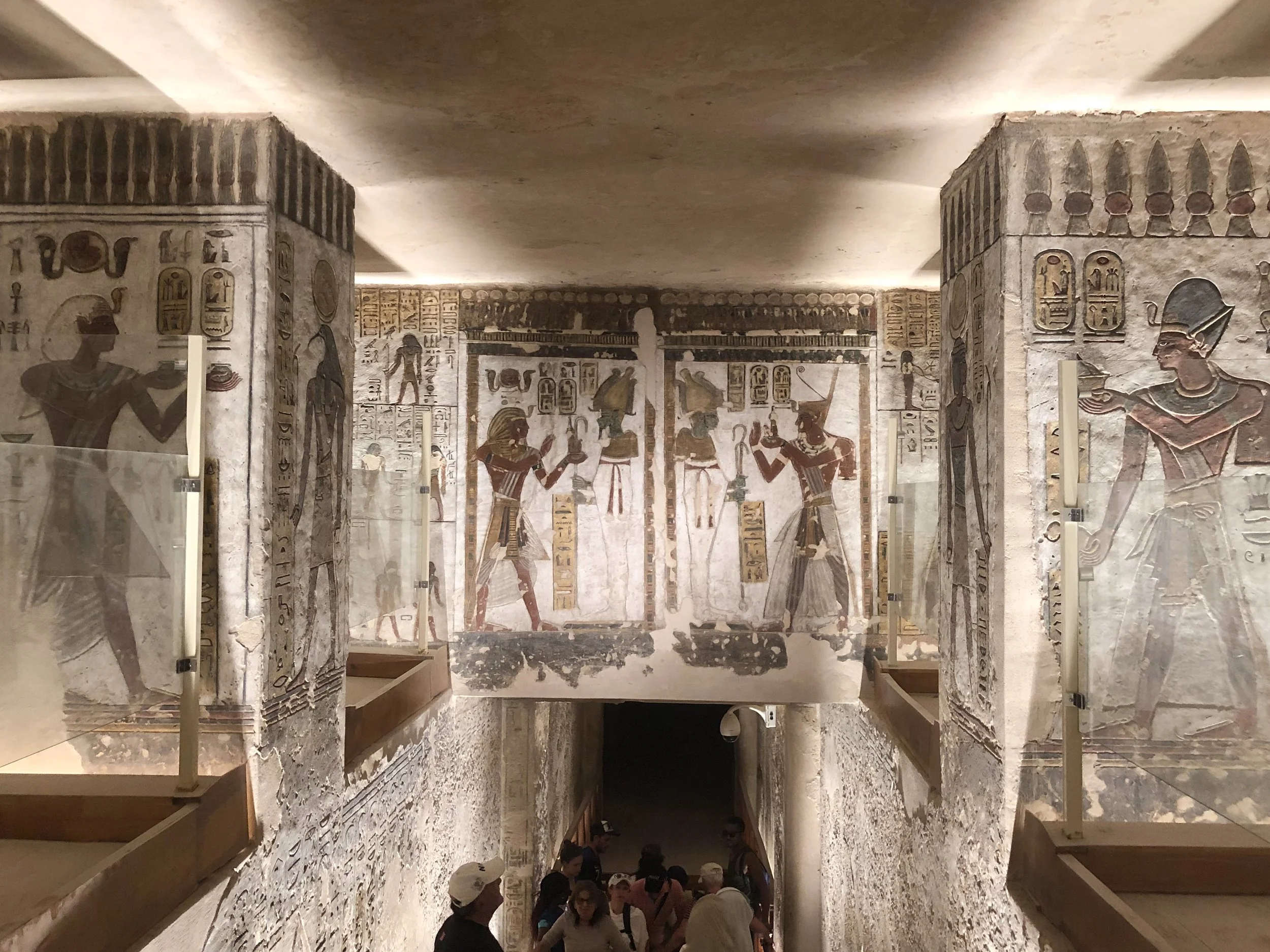
The New Kingdom of Egypt (roughly 1570–1069 BCE) really was the ultimate golden age for ancient Egypt. After a turbulent period, Egypt didn't just recover; it exploded into a powerful empire, with pharaohs extending their reach from Nubia all the way into the Near East. This time, often called the 'Empire Age,' covers the 18th, 19th, and early 20th Dynasties. It's when Egypt was at its absolute peak in terms of wealth, military muscle, and cultural sway. Think monumental temples like Abu Simbel and Luxor, and Thebes thriving as a serious religious hub. The stability and sheer scale of achievements from the New Kingdom still just grab hold of you today.


The Rise of the New Kingdom of Egypt
Ancient Egypt's map changed dramatically, around 1782 BCE. The mighty Middle Kingdom crumbled, and outsiders started taking over. The Hyksos, who came from West Asia, grabbed control of Lower Egypt, while down south, the Kingdom of Kush rose up. This split power, known as the Second Intermediate Period, might have seemed like chaos, but it actually paved the way for Egypt's strongest era yet.The Fall of the Hyksos and Reunification Under Ahmose I
The conflict with the Hyksos really kicked off when Egyptian king Seqenenra Tao saw a message from Hyksos king Apepi as a direct challenge. Tao died in battle, but his son Kamose picked up the fight, claiming he'd beaten the Hyksos after attacking Avaris. But, if you look at the historical records, Avaris actually stayed under Hyksos control until Ahmose I took the throne (around 1539-1514 BCE). It was Ahmose I, Kamose's brother, who finally booted the Hyksos out for good. He pushed them out through a really determined military campaign. He started by capturing Memphis, Egypt's traditional capital, then launched a water assault on Avaris, swiftly followed by a land siege. Once Avaris fell, Ahmose chased the Hyksos all the way to Sharuhen in Palestine. That city held out for three years, but it eventually fell. This decisive victory marked the end of foreign rule and the start of the glorious New Kingdom.Establishing Buffer Zones and Military Reforms
Ahmose I was smart; he immediately set up buffer zones around Egypt to prevent any future invasions. He secured Egypt's borders by launching military campaigns into Nubia to the south and pushing into Canaan and Syria to the northeast. He brought Nubia back under Egyptian control and even built a new administrative center at Buhen. The military itself underwent a complete makeover during this time. For the first time in Egyptian history, New Kingdom armies had full-time soldiers working together as a state-level force. The Egyptians didn't just copy the Hyksos' military innovations; they improved them. Things like the chariot, the composite bow, and bronze weapons all got upgrades. These advancements truly helped Egypt stand its ground against the powerful Near Eastern kingdoms that came later.The Role of Thebes as a Political and Religious Center
Thebes, under Ahmose's rule, became the new capital. People called it by its sacred name, P-Amen or Pa-Amen, which beautifully translates to 'the abode of Amun.' The Karnak temple complex grew massively in importance, while the older Ra cult based in Heliopolis became less significant. You can even see stone slabs at Karnak showing Ahmose's contributions to the temple, painting him as a truly generous supporter. Ahmose I's reunification of Egypt breathed new life into royal art and monumental building projects. This burst of culture, combined with serious military might and expanding territory, really set the stage for Egypt's golden age.
The 18th Dynasty: Expansion, Innovation, and Reform
The Eighteenth Dynasty of Egypt, spanning from around 1550 to 1292 BC, really was a golden era. It brought incredible territorial growth and cultural achievements that defined the New Kingdom. Several powerful rulers helped Egypt become a global superpower with an empire stretching from Syria all the way to Upper Nubia.Want to explore The New Kingdom of Ancient Egypt?
Let us design the perfect private itinerary for you. From expert local guides to seamless luxury cruises, we craft custom trips that show you the real Egypt.
Customize via WhatsAppHatshepsut's Trade Expeditions and Building Projects
Queen Hatshepsut, who ruled for more than twenty years (around 1479-1458 BC), stands out as the longest-serving woman pharaoh from an indigenous Egyptian dynasty. She wisely prioritized economic growth over military conquest, rebuilding trade networks that had fallen apart during the Hyksos' time. Her famous expedition to the mystical Land of Punt brought back 31 live myrrh trees, frankincense, and a treasure trove of other luxury items. Fun fact: she was the first to use charred frankincense as kohl eyeliner – a truly groundbreaking use of this resin! Hatshepsut's building legacy is genuinely among Egypt's most impressive. She commissioned hundreds of construction projects across both Upper and Lower Egypt. Her architectural achievements were simply remarkable: * She restored the Precinct of Mut at Karnak, a significant undertaking. * She built twin obelisks at Karnak Temple's entrance, which were the world's tallest at the time. * She created the Temple of Pakhet at Beni Hasan. * Her masterpiece, the Djeser-Djeseru ('the Holy of Holies') at Deir el-Bahari, is still breathtaking today.
Thutmose III and the Creation of the Egyptian Empire
After Hatshepsut passed away, Thutmose III emerged as Egypt's greatest military pharaoh, hands down. He led an astonishing 17 to 20 successful campaigns. Historian Richard A. Gabriel even dubbed him the 'Napoleon of Egypt,' and you can see why. His conquests helped Egypt grow into an empire that stretched from the Euphrates well into Nubia. He even made history by creating Egypt's first navy! His victory at the Battle of Megiddo (May 9, 1457 BC) gave him control of northern Canaan, and kings from Assyria, Babylonia, and Hatti all paid him tribute throughout his reign.Amenhotep III and the Golden Age of Diplomacy
Amenhotep III's reign (around 1388-1351 BC) brought an unparalleled age of prosperity and international influence. The famous Amarna Letters show his incredible diplomatic skills through correspondence with rulers from Assyria, Mitanni, Babylon, and Hatti. He managed to keep Egypt's position as the leading power in the ancient Near East through smart alliances and strategic gift exchanges. People affectionately called him 'Amenhotep the Magnificent.' He commissioned more than 250 statues – more than any other pharaoh – and celebrated three Sed festivals. Only Ramesses II's much longer reign could even come close to his extensive building program.Akhenaten's Religious Revolution and the Amarna Period
Then we have Akhenaten (around 1353-1336 BC), who completely reshaped Egyptian religion. He elevated the sun disk, Aten, from being a prominent deity to becoming the one and only god. He even built a brand-new capital called Akhetaten (modern Amarna). This religious shift also brought about revolutionary artistic styles. Artists depicted the royal family with elongated heads, thin limbs, and distinct stomach paunches – a complete departure from traditional Egyptian art. These changes allowed Akhenaten to position himself as the sole link between the people and the Aten.Want to explore The New Kingdom of Ancient Egypt?
Let us design the perfect private itinerary for you. From expert local guides to seamless luxury cruises, we craft custom trips that show you the real Egypt.
Customize via WhatsAppTutankhamun and the Restoration of Tradition
Tutankhamun became pharaoh at just nine years old, inheriting the total chaos left by Akhenaten's religious revolution. His reign, though short, brought about one of Egypt's greatest restorations. The Restoration Stela from Year 4 of his reign frankly describes the Amarna Period as disastrous. He quickly ditched his father's radical monotheistic vision. He brought back the traditional gods and moved the capital from Amarna back to Memphis. The young pharaoh strongly supported important religious cults, especially those of Amun and Ptah. Even though his reign was brief, his efforts to restore traditional Egyptian religion were critical in shaping the future dynasties of the New Kingdom.
The 19th and 20th Dynasties: Power, Glory, and Decline
During the 19th and 20th Dynasties, the New Kingdom of Ancient Egypt hit its absolute peak, but also began its slow, inevitable decline. Egypt faced its toughest military challenges ever, yet still achieved diplomatic successes that would echo through history.Ramesses II and the Battle of Kadesh
'Ramesses the Great' literally met the mighty Hittite Empire at Kadesh in 1274 BCE in what was history's largest chariot battle, involving a staggering 5,000-6,000 chariots. The pharaoh himself barely escaped an ambush and had to lead several counterattacks with his personal guard. Egyptian records claimed a victory, but modern historians largely see it as a strategic stalemate – neither side truly won.The First Peace Treaty in History
The fighting dragged on for 15 years until Ramesses II and Hittite king Hattusili III signed what we now recognize as the world's oldest peace treaty in 1258 BCE. Silver tablets carried this groundbreaking agreement that spelled out some truly important points: * Eternal friendship and lasting peace between Egypt and the Hittite Empire. * Mutual defense against outside threats. * Guarantees for territorial integrity and the extradition of political refugees. * Pledges to solve any future disputes peacefully. It's pretty amazing to think that the United Nations headquarters now displays a replica of this historic treaty.Ramesses III and the Defeat of the Sea Peoples
Ramesses III of the 20th Dynasty faced a life-or-death struggle against the mysterious Sea Peoples, who had already devastated several Mediterranean civilizations. He crushed them in two decisive battles during his eighth year as ruler (around 1178 BCE). The pharaoh first stopped their land invasion at Djahy in southern Lebanon, then set a clever naval trap at the Nile Delta. Egyptian ships blocked their escape route while archers lined the shore. This victory was massive, but it came at a steep price that slowly drained Egypt's wealth.Economic Strain and Internal Unrest
By the end of Ramesses III's reign, Egypt was seriously struggling with money problems. Workers at Deir el-Medina staged history's first recorded strike in his 29th year because they hadn't received their grain payments. The kingdom suffered from droughts, weak Nile floods, ongoing food shortages, and corrupt officials. These environmental issues decimated grain supplies, hurt trade, and fundamentally weakened the New Kingdom's foundations.The Rise of the Priests of Amun
The priesthood of Amun at Thebes grew incredibly powerful as royal authority started to wane. By the late New Kingdom, they controlled two-thirds of all temple lands and 90 percent of Egypt's ships. Karnak's Temple of Amun alone managed 433 orchards, 421,000 livestock, 65 villages, and employed over 81,000 people. The high priests effectively ruled Upper Egypt, making major state decisions through oracles of Amun during the Third Intermediate Period. This dramatic power shift truly marked the end of Egypt's greatest era of imperial glory, a story that still fascinates travelers exploring these ancient sites on an Egypt tour.
The Fall of the New Kingdom and Its Legacy
After Ramesses III's long reign, the New Kingdom of Ancient Egypt slowly but surely began its inevitable decline. Its official end came with Ramesses XI's death in 1077 BCE, which kicked off the Third Intermediate Period – a time of real political division and a weak central authority.Division of Power Between Thebes and the Delta
As the 20th Dynasty drew to a close, power fragmented into two main centers. The High Priests of Amun held sway from Thebes in Upper Egypt, while secular rulers governed from Tanis in the Delta region. This division, interestingly, happened rather peacefully, unlike earlier intermediate periods. Amun's priesthood had become ridiculously powerful in Thebes, owning two-thirds of all temple lands and a whopping 90% of Egypt's ships. The god Amun effectively became Thebes's actual ruler, with priests making state decisions by 'consulting' him through oracles.Loss of Central Authority and Foreign Invasions
Egypt's power continued to fracture throughout the Third Intermediate Period. The country had, unbelievably, split into nine major kingdoms by the late 8th century BCE. This political free-for-all made Egypt incredibly vulnerable to outside powers. The Nubians arrived first, establishing the 25th Dynasty around 730 BCE. Then came the Assyrians, who brutally sacked Thebes in 663 BCE. Finally, the Persians conquered Egypt in 525 BCE, ending native rule for the first time in its 2,500-year history.Cultural and Religious Influence on Later Periods
Despite its political collapse, the New Kingdom's cultural legacy lived on, resilient and powerful. The temple building programs from this era created architectural styles that influenced centuries of construction. The religious practices centered around Osiris dominated almost every temple. Even under foreign rule, Ptolemaic kings validated their power by publicly performing traditional pharaonic duties before Egyptian deities. And get this: Egyptian mummification practices actually lasted until the seventh century CE – almost two thousand years after the New Kingdom fell. That's a legacy that truly endures.Ready to turn this guide into reality?
Our local experts can create a custom itinerary based on these recommendations. Just send us a quick message!
Customize via WhatsApp