
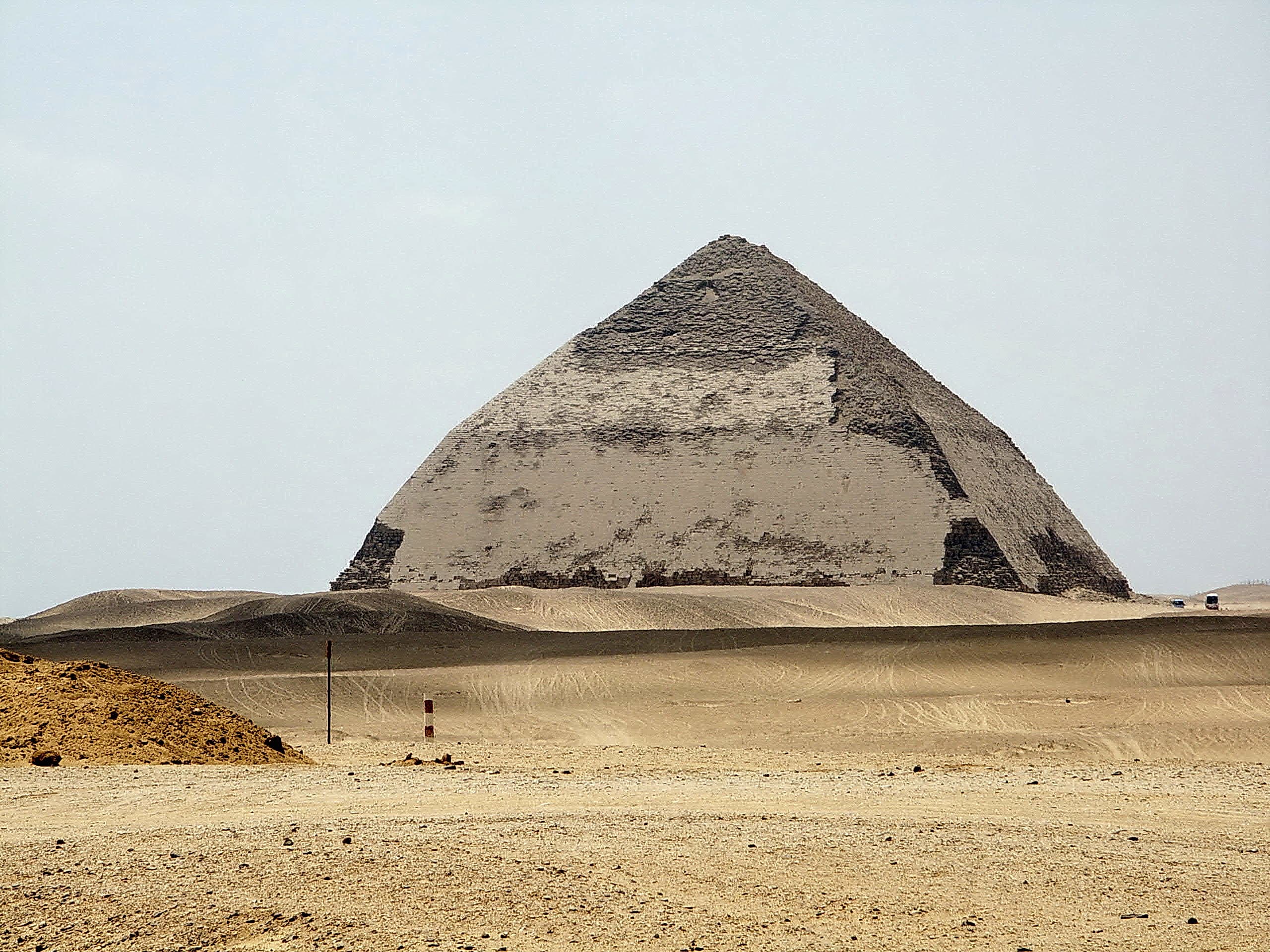

Alright, let's talk about the Bent Pyramid. Honestly, it's one of Egypt's most endlessly fascinating structures. That peculiar 'bend' isn't just a quirky feature; it's a giant, visible scar of an architectural struggle, a moment caught in time when ancient engineers were figuring things out, trial by trial.
Pharaoh Sneferu, way back around 2600 BCE, during the 4th dynasty, was the man behind it. Imagine his ambition! This pyramid shoots up from the desert, originally at a super steep 54-degree tilt, then abruptly shifts to a gentler 43-degree angle about 47 meters up. That's why it's 'bent,' and it’s been puzzling and delighting people for millennia. What's even wilder? Much of its polished limestone casing, the stuff that made it gleam under the desert sun, is still right there, largely intact.
Most other ancient pyramids lost theirs ages ago, scavenged for other buildings.
The Bent Pyramid, nestled in Dahshur, isn't just a cool-looking building; it's a pivotal point in Egyptian history. Standing at 104.71 meters (about 344 ft) with a massive 189.43-meter (621 ft) base, it literally embodies the shift from those earlier step-sided pyramids to the smooth, iconic shapes we all recognize. And if that isn't enough, it boasts two separate entrances on different faces, which was pretty unheard of for Old Kingdom structures. The best part?
After being off-limits for decades, Egypt finally opened it up to tourists again in July 2019. If you get the chance, go inside – it's like stepping into Sneferu's personal engineering workshop.
Who was Sneferu and why did this pyramid matter so much?
Pharaoh Sneferu, the dude who kicked off Egypt's Fourth Dynasty (from 2613-2589 BCE), wasn't just building tombs; he was revolutionizing an entire field of engineering. His architectural experiments here at Dahshur were so groundbreaking that they directly inspired his son, Khufu, to build what would become the Great Pyramid of Giza. Sneferu's 'failures' and solutions became the bedrock (pun intended!) for Egypt's most iconic monuments.
Pharaoh Sneferu and the Fourth Dynasty
The Fourth Dynasty? That was the golden age of Egyptian architecture, and Sneferu was its undisputed star. Most pharaohs were happy with one fancy tomb, but Sneferu? He built at least three colossal pyramids: the Meidum Pyramid, this Bent Pyramid, and the Red Pyramid. His building frenzy wasn't just about showing off; it was a relentless pursuit of perfection, a dedication to honing the pyramid form until it reached that smooth, true shape.
Under his reign, Egyptian architecture truly transitioned from those stair-like step structures to the sleek, smooth-sided pyramids.
The pyramid's role in royal burial development
The Bent Pyramid is a watershed moment in royal tomb design. It literally captures the evolution between King Djoser's funky step-pyramid in Saqqara and the smooth-faced wonders that scream 'Egypt!' to the world. But it wasn't just about the aesthetics. These changes were deeply tied to evolving religious beliefs. Scholars think the switch from steps to smooth sides reflected a new understanding of the afterlife.
The tomb wasn't just a ladder to the stars anymore; it became a symbol of the sun cult, connecting the deceased king directly with the sun god and the primeval origins of life itself.
Connecting the dots: Red and Meidum pyramids
To truly get the Bent Pyramid, you need to understand its siblings. The Meidum Pyramid was Sneferu's first big project. It started as a stepped pyramid, then they tried to convert it into a 'true' smooth-sided one. Didn't work out so well; that steep angle was just too unstable. Learning from that, Sneferu started the Bent Pyramid—his initial shot at building a smooth-sided pyramid from the ground up, no steps. But even that ran into trouble.
And that's where the Red Pyramid comes in. Located just 2 kilometers away from the Bent, this was Sneferu's final masterpiece. All the lessons, all the headaches, all the engineering breakthroughs from Meidum and the Bent Pyramid were poured into it. The Red Pyramid, with its much safer 43-degree angle, became Egypt's first successfully finished smooth-sided pyramid. It was the perfect blueprint, the ultimate model, that led directly to the colossal pyramids of Giza.
See it for yourself
Trips that visit the places in this article.

This 8-day tour combines Cairo's pyramids with a four-night dahabiya sailing aboard the Three Pyramids vessel, following the Luxor-to-Aswan route with an Abu…

This 12-day family itinerary moves from Cairo's monuments to a Nile cruise between Aswan and Luxor and finishes with an extended, all-inclusive stay on the Red…
Want a different route or length? We'll build it around you.
The Mystery of the Bend: Design challenges and ingenious solutions
Now, let's talk about the 'bent' part. It's the pyramid's signature, its most striking feature, and it’s been the subject of endless debate among archaeologists for generations. Was it an engineering screw-up that they had to correct on the fly, or was it some intentional, symbolic design choice? The evidence points pretty strongly to the former, and honestly, that makes it even more human and relatable.
Want to explore The Bent Pyramid: A Glimpse into Ancient Egyptian Architectural Evolution?
Let us design the perfect private itinerary for you. From expert local guides to seamless luxury cruises, we craft custom trips that show you the real Egypt.
That ambitious, steep angle and lurking structural worries
When they started, the lower section was incredibly ambitious, soaring skyward at a crazy steep 54°31'13" angle. The builders were confident, but they hit a massive snag: the foundation. They weren't building on solid bedrock, but on soft ground with a layer of salty clay. As the massive limestone blocks piled up, the sheer weight began to compromise the structure's integrity. Cracks were appearing, the ground was shifting—it was an ancient engineer's worst nightmare.
The sudden shift: from 54° to 43°
About 47 meters up, they hit the brakes in a big way. The angle drops dramatically to a much gentler 43°21'. You can spot this correction from miles away, creating that distinctive 'bent' silhouette. But this wasn't just an aesthetic tweak; it was an entire rethinking of their building method. They’d been laying the lower stones sloping inward, but for the upper section, they switched to horizontal courses. That switch alone tells you they went back to the drawing board mid-construction.
Was it a design flaw or a choice?
Okay, so theories abound. Most scholars lean towards structural issues forcing the change. It's likely they saw cracks forming in the chambers and corridors, a terrifying sign. To prevent imminent collapse, they had to drastically reduce the angle. Plus, let's be real, a 54-degree slope makes building ramps and hauling stones incredibly difficult as you get higher.
While some romantics suggest it was a planned design, symbolizing duality (what with its two entrances and two internal layouts), the hard evidence of structural fixes points much more strongly to good old-fashioned engineering challenges driving the decision.
Construction phases and the birth of new building techniques
Archaeological digs have revealed that the Bent Pyramid wasn't built all at once; it was a multi-stage project, with each phase marking significant advancements in ancient Egyptian engineering.
Want to explore The Bent Pyramid: A Glimpse into Ancient Egyptian Architectural Evolution?
Let us design the perfect private itinerary for you. From expert local guides to seamless luxury cruises, we craft custom trips that show you the real Egypt.
Phase 1: The super steep (and unstable) beginning
Sneferu's initial vision was incredibly daring: a base of 157 meters and an inclination of roughly 58° to 60°. If they'd pulled it off, it would have been a staggering 125-meter-tall pyramid. But with the building methods of the time, that steep angle was just too unstable. They were pushing the limits, and the limits pushed back.
Phase 2: The angle gets a little less aggressive, base expands
So, the builders adjusted. They reduced the angle to 54° and beefed up the base to 188 meters. Here's a cool detail: they were still using inclined wall layers, a technique carried over from earlier step pyramids. Why? Because they hadn't quite mastered cutting those perfect trapezoidal stones yet. For this phase, they started bringing in fine Tura limestone from across the Nile for a better finish.
Phase 3: The horizontal breakthrough and the final shape
This is where the real innovation happened. For the final section, the angle dropped to 43°, and crucially, they laid the masonry in horizontal layers. This was a game-changer! It became the standard technique for all pyramids that followed. With this reduced angle, the pyramid reached its final height of 105 meters, boasting a colossal volume of 1.44 million cubic meters. Remarkable.
The beauty of limestone: Local and Tura casing
For the pyramid's core, they used local limestone, practical and strong. But for that dazzling exterior? They schlepped higher-quality Tura limestone all the way from the other side of the Nile. It's this outer layer that's stayed so incredibly intact, making the Bent Pyramid one of the rare ancient structures that still flaunts its original, smooth, polished surface. It must have glowed like a beacon.
Ramp systems and a skilled workforce
Building these giant structures meant some serious logistics. They almost certainly used complex ramp systems, though those would have gotten progressively harder to manage as they neared the top. Newer theories even suggest they used water or wet clay to slick the path, helping them drag those massive stones on sledges.
And forget the old Hollywood myths of slaves toiling away; evidence points to a highly organized, skilled workforce of about 2,000 people on site at any given time, paid and well-fed. These were master craftsmen and laborers, not captives.
Ready to turn this guide into reality?
Our local experts can create a custom itinerary based on these recommendations. Just send us a quick message!
Customize via WhatsApp